Disclosure: This article may contain affiliate links. If you purchase through these links, the publisher may receive compensation at no extra cost to you. This is not medical advice. Statements about dietary supplements have not been evaluated by the FDA. Consult a healthcare professional before starting any supplement.
Overview
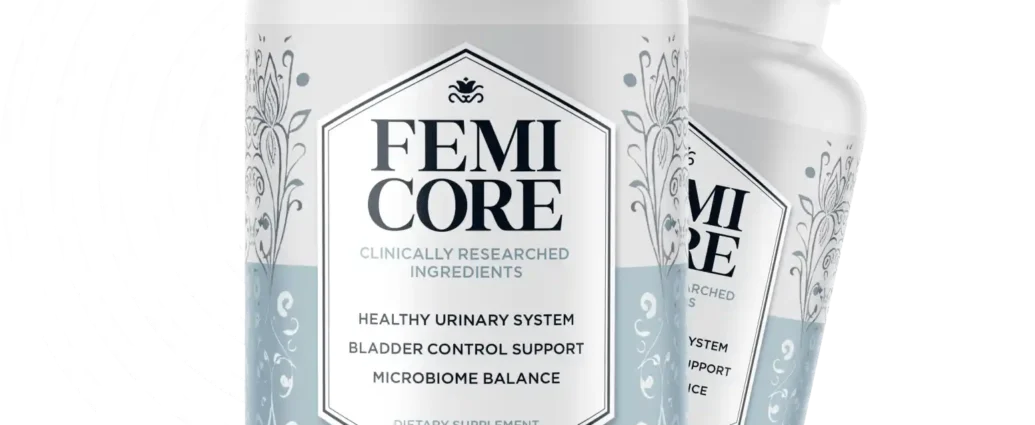
FemiCore is a once-daily capsule marketed primarily to women for bladder control support, urinary system health, and microbiome balance. Each bottle holds 30 capsules, and the label directs adults to take one capsule daily with 6–8 oz of water.
The formula combines four botanical ingredients with five Lactobacillus strains in a single capsule. The 350 mg herbal blend contains Mimosa pudica seed extract, cranberry extract standardized to 30% proanthocyanidins, bearberry (Arctostaphylos uva-ursi) leaf, and berberine HCl extract at 8%. The 50 mg probiotic blend lists L. crispatus LCr86, L. acidophilus LA88, L. plantarum N13, L. gasseri LG08, and L. casei LC16.
The product is sold through the official website with ClickBank named as the retailer of record, and carries a 60-day money-back guarantee counted from delivery. Pricing runs from $79 per bottle at two bottles** down to **$49 per bottle at six, with free US shipping on the six-bottle pack.
The premise — that the urinary microbiome influences bladder symptoms — is a legitimate and active area of research. The limitation is that the finished FemiCore formula has never been tested in a published clinical trial, and the individual ingredient doses are not disclosed.
What’s in It
What’s disclosed: every ingredient and every probiotic strain code by name — a genuine transparency win over unnamed proprietary blends.
What’s not disclosed: the milligram amount of any individual herb and the probiotic CFU count. The 350 mg blend does not state how much is cranberry, which means the one ingredient with real evidence has an unknown dose. Without those numbers, the formula cannot be matched to the research that makes its ingredients interesting.
How It’s Positioned to Work
The marketing describes a microbiome-imbalance mechanism: harmful bacteria irritate the bladder, trigger involuntary muscle contractions, and produce sudden leaks; the formula is claimed to “repopulate” the urinary microbiome with beneficial Lactobacillus and eliminate the bad bacteria. The FAQ goes further, claiming the formula targets “toxic dioxins that can throw your urinary microbiome out of balance”.
Where the science genuinely supports the premise:
The female bladder does contain microbial communities, and those communities differ in women with incontinence. A 2024 study of 126 women found that those with more Lactobacillus in their urinary microbiome had fewer total and urgency-related leakage episodes — women with less Lactobacillus had about 2.7 more total leaks and 1.8 more urgency leaks per day. Higher bacterial diversity without Lactobacillus dominance has also been associated with urgency incontinence and resistance to anticholinergic treatment.
Where the logic breaks:
That is an association, not a causal finding. No published trial has tested whether swallowing these specific five strains changes the urinary microbiome enough to reduce leaks. And the “dioxin” narrative is unsupported — the seller’s reference list cites real papers on the urinary microbiome, then pads it with news coverage about tampons. One reviewer’s summary is precise: “The ingredient list is public. The doses are not.”

What It May Be Good For
A reasonable recurrent-UTI-style formula. This is the most defensible use case. Cranberry proanthocyanidins are the only ingredient with strong human evidence, and the 2023 Cochrane review supports them for reducing symptomatic UTIs in women with recurrent infections. A woman whose main complaint is repeat infections is the best-matched buyer.
Urgency and frequency support. Women who report useful results are consistently the urgency-and-irritation type, taking one capsule daily for at least 6–8 weeks, usually alongside pelvic-floor work.
A convenient single capsule. Four botanicals and five probiotic strains in one daily capsule is simpler than assembling separate bottles, and the strain codes are disclosed — more than many competitors offer.
A processor-backed refund. ClickBank is the named retailer, and its self-service order lookup at clkbank.com lets you request a refund yourself, independent of whether the seller answers email.
What to Keep Expectations Realistic About
Stress incontinence. If your leaks happen when you cough, sneeze, laugh, run, or lift, that is a pelvic-floor muscle problem, and nothing in this capsule reaches those muscles. One verified reviewer describes exactly this outcome: “The constant ‘I need to go now’ feeling eased up around week four. The sneeze leaks are exactly what they were”.
Individual doses. The 350 mg herbal blend hides the cranberry amount, and the 50 mg probiotic blend has no CFU count.
A finished-product trial. None exists. Whatever evidence exists is ingredient-level, tested separately, often for different outcomes — cranberry for recurrent UTIs, not urgency or leaks.
The “dioxin” story. No published trial supports it, and the reference list leans on news articles rather than studies.
The review count. The sales page’s “19,263 reviews” is the seller’s own count, not an independent aggregate.
“Permanent support.” The sales page uses this phrase, and no supplement evidence backs permanence.
**The “$179 regular price.”** That is a **marketing anchor**; no evidence indicates buyers ever paid it. The real prices are $79 / $69 / $49.
Who It Suits
- Women in their 40s–70s whose main complaint is urgency, frequency, or recurring UTI-type irritation, and who have already been evaluated for active infection
- Women who want cranberry, bearberry, berberine, and a Lactobacillus blend in one capsule rather than separate bottles
- Those with urge-type or mixed leaks already doing pelvic-floor training who want a non-prescription add-on to discuss with a clinician
- Buyers willing to commit to a consistent 60-day trial and track symptoms with a bladder diary
- Anyone who values a processor-backed checkout and a written refund policy over a marketplace listing
Who Should Skip It
- Women whose leaks occur with coughing, sneezing, laughing, running, or lifting — that is stress incontinence, and the formula has no ingredient that acts on pelvic-floor muscle
- Anyone with fever, flank pain, blood in the urine, or an active UTI — those need a clinician
- Pregnant or breastfeeding women — both bearberry and berberine are contraindicated
- Women taking cyclosporine, diabetes medication, statins, or warfarin without prescriber clearance. Berberine has a documented interaction with cyclosporine and inhibits CYP2D6, CYP2C9, and CYP3A4 — enzymes that clear many statins and other drugs — while cranberry has a widely listed warfarin interaction
- Anyone who wants to test a single bottle — the smallest pack is two bottles at $158 plus $9.99 shipping, and there is no single-bottle option
- Shoppers who cannot verify the checkout domain — trust scores across FemiCore-branded domains range from 0 to 50, with several flagged as suspicious or recently registered
Bottom Line
FemiCore is a real product with a public ingredient list, disclosed probiotic strain codes, and a processor-backed 60-day refund — and its central idea, that the urinary microbiome matters for bladder symptoms, is genuinely supported by association-level research. The cranberry component has the strongest human evidence in the formula, with a 2023 Cochrane review of 50 trials behind it.
Its limitations are the ones that define the microbiome-supplement category. No individual herb doses and no probiotic CFU count are published, the finished formula has no clinical trial, the “dioxin” narrative is unsupported, and the sales page outruns the evidence with “permanent support” language. The formula also does nothing for stress incontinence, which is where many disappointed buyers went wrong. Add a $158 minimum entry point, an inconsistent shipping description, and domain trust scores ranging from 0 to 50, and the buyer needs to read carefully.
Buy it if your main problem is urgency, frequency, or recurrent UTI-type irritation, you have already been checked for infection, you are already doing pelvic-floor work, you will buy only through the official ClickBank checkout, and you will keep a bladder diary and set a day-50 refund reminder. Skip it if you leak when you cough or sneeze, you are pregnant or breastfeeding, you take interacting medication without prescriber clearance, or you need disclosed doses before spending — because at $158 minimum and no finished-formula evidence, this is a structured personal experiment, not a proven treatment.
This article is for informational purposes only and is not medical advice. Statements about dietary supplements have not been evaluated by the FDA. Consult a healthcare professional before starting any supplement.
*Editor’s notes: (1) Confirm or remove the author byline — do not use “Dr./MD” unless verified. (2) The stress vs. urgency incontinence distinction is the single most important consumer-protection point in this review and must remain in the final copy — no capsule addresses pelvic-floor muscle. (3) The berberine–cyclosporine and CYP enzyme interactions and the pregnancy/breastfeeding contraindication for berberine and bearberry are the relevant safety disclosures; do not trim them. (4) The *$179 “regular price” is an anchor**; the real prices are $79/$69/$49, and there is no single-bottle option — the minimum real spend is about $158. (5) The “19,263 reviews” figure is the seller’s own count, not an independent aggregate. (6) Note that FemiCore and FemiPro share an identical formula and distributor — readers should not buy both. (7) Do not link to any of the low-trust domains named in this review; link only to the verified ClickBank checkout if linking at all. (8) Do not add testimonials or urinary-efficacy claims beyond what is attributed here.