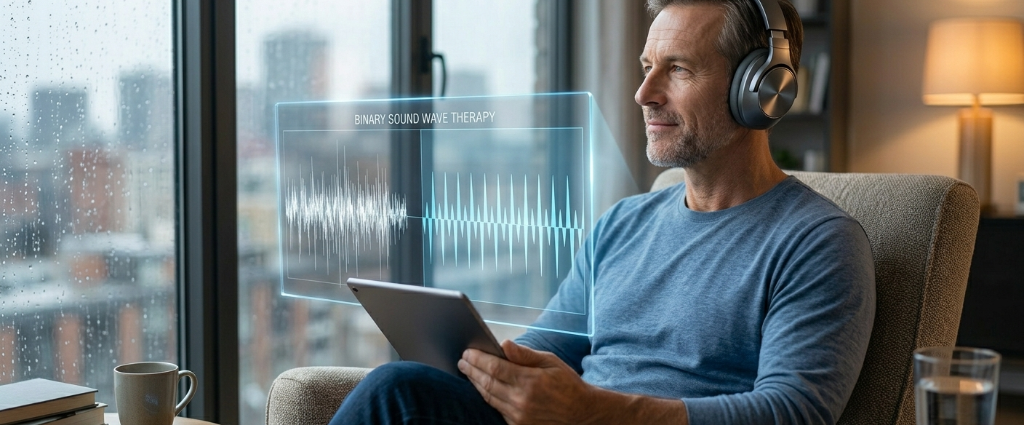
Neurotinn Reviews :Tinnitus affects over 740 million people worldwide, and for many, the constant ringing, buzzing, or hissing can be debilitating. The condition is not a disease itself but a symptom of underlying neural changes—most commonly linked to hearing loss and the brain’s compensatory mechanisms.
Dr. Michael Thorne’s Neurotinn presents itself as a precision binaural therapy tool developed from 27 years of neuro-auditory research. Unlike masking devices that simply add noise, Neurotinn claims to interrupt the neural loop generating tinnitus. This review examines the science behind Neurotinn, its mechanism of action, and the evidence supporting its claims.
What Is Neurotinn?
Neurotinn is a browser-based binaural beat therapy tool designed to reduce tinnitus perception by targeting the brain’s central gain amplification mechanism. The product was developed by Dr. Michael Thorne, who holds a PhD from Johns Hopkins and has dedicated 27 years to clinical research in neuro-auditory science.
The therapy involves listening to binaural beats through headphones. Each ear receives a slightly different frequency, and the brainstem perceives the mathematical difference between them, synchronizing its electrical activity toward that frequency—a phenomenon known as the frequency-following response.
Neurotinn is sold as a one-time purchase ($47) with lifetime access, rather than a subscription model. It includes four calibrated presets, ambient sound options, a live frequency display, and a session timer. The product is backed by a 60-day money-back guarantee, allowing users to try it risk-free.

The Science Behind Neurotinn
Neurotinn’s approach is built on three core scientific concepts: central gain amplification, binaural beats, and neuroplasticity. Each of these has solid foundations in auditory neuroscience.
Central Gain Amplification
The product describes tinnitus as resulting from “Central Gain Amplification,” where the brain turns up its internal volume to compensate for reduced hearing input. This is a well-documented phenomenon in auditory neuroscience.
When hearing loss occurs—whether from noise exposure, age, or other causes—peripheral input to the auditory system decreases. The brain compensates by increasing neural gain, which amplifies both external sounds and internal neural noise. This amplified spontaneous activity is perceived as tinnitus.
As one academic paper explains: “In cases of hearing loss, the input I is effectively reduced. Therefore, to reach the same neural threshold, one could either increase central noise N, or central gain G, or both.” This is precisely the mechanism Neurotinn targets.
Binaural Beats and the Frequency-Following Response
Binaural beats are created when each ear receives a slightly different tone. The brainstem perceives the mathematical difference and begins synchronizing its electrical activity toward that frequency. This is electroencephalography-confirmed neurophysiology.
Research supports the potential of binaural beats for tinnitus. A 2024 study published in the European Archives of Otorhinolaryngology evaluated delta frequency binaural beats in individuals with tinnitus. The study found “a considerable reduction of tinnitus handicap scores, depression and anxiety levels” after 30 days of stimulation. The researchers concluded that “delta wave stimulation acted as a helpful tool in improving tinnitus borne distress symptoms.”
Another 2024 study combined binaural beats with music therapy. Both groups showed significant improvements in tinnitus-related outcomes, and the binaural beats group showed “even greater improvements in follow-up” on certain measures, suggesting “changes in neural response and brain waves caused by our stimulations are persistent.”
Neuroplasticity
The claim that repeated sessions can “retrain the signal” relies on neuroplasticity—the brain’s ability to reorganize itself. Neuroplastic changes in the auditory system are well-documented, and the idea that consistent auditory stimulation can reshape neural pathways is supported by decades of research.
What the Research Says About Binaural Beats and Tinnitus
Positive Findings
A 2024 study published in the European Archives of Otorhinolaryngology specifically evaluated delta frequency binaural beats for tinnitus. Twenty-four participants used delta frequency binaural beats for 30 days. The results showed “a considerable reduction of tinnitus handicap scores, depression and anxiety levels.” The study concluded that “apart from a few individuals, the delta wave stimulation acted as a helpful tool in improving tinnitus borne distress symptoms.”
Another 2024 study combined music therapy with alpha frequency (8 Hz) binaural beats. Both groups improved, but the binaural beats group showed “even greater improvements in follow-up” on emotional and functional subscales.
Limitations and Considerations
The evidence has several limitations. The 2024 delta wave study involved only 24 participants and noted that “few of the participants showed limited or negligible improvement post-treatment.” The researchers emphasized the need for “extensive research involving an extended treatment duration on a larger population” before clinical adoption.
A 2021 study comparing sound therapies found that “binaural sounds and neuromodulation produced very similar effects at reducing tinnitus perception, stress and anxiety.” Importantly, this study found that “music treatments can be applied with caution since they may worsen the condition due to their frequency content.”
An umbrella review of tinnitus interventions published in 2026 analyzed 44 systematic reviews covering 7 intervention domains. It found that Cognitive Behavioral Therapy (CBT), hearing aids, Tinnitus Retraining Therapy (TRT), and sound/music therapy “consistently improved tinnitus-related outcomes.” Neuromodulation and acupuncture showed “modest or inconsistent benefits with high heterogeneity.” Sound/music therapy was included among consistently beneficial approaches.
Neurotinn Reviews: What Are Users Saying?
The Neurotinn website features testimonials from users reporting significant benefits:
- R. Callahan, a retired firefighter from Ontario, reports sleeping through to 6 a.m. for the first time in three years after nine years of tinnitus.
- Marcus T., a session musician from Nashville, uses the Beta protocol for concentration during recording sessions.
- Diane K., a retired teacher, describes Neurotinn as the first tool that “actually lets me manage it on my own terms.”
These testimonials reflect personal experiences and individual results vary. The website also offers a 7-day relief guarantee and a 60-day money-back guarantee for users who want to try the product without risk.
How Neurotinn Compares to Alternatives
| Intervention | Key Evidence | Advantages | Limitations |
|---|---|---|---|
| Cognitive Behavioral Therapy (CBT) | Consistently improves tinnitus distress | Strong clinical evidence | Requires therapist, time commitment |
| Tinnitus Retraining Therapy (TRT) | Consistently improves tinnitus outcomes | Well-established protocol | Expensive, lengthy process |
| Hearing Aids | Recommended for hearing loss with tinnitus | Addresses root cause | Only for those with hearing loss |
| Sound/Music Therapy | Consistent benefits for tinnitus | Non-invasive, accessible | Results vary |
| Neurotinn | Based on binaural beat research | One-time payment, browser-based, no subscription | Newer approach, less clinical data |
Who Should Consider Neurotinn?
Neurotinn may be a good option for:
- Individuals who have tried masking devices without success and want to explore binaural beat therapy
- Those seeking a non-invasive, low-cost tool to complement existing tinnitus management strategies
- People who understand that results vary and are willing to use the tool consistently
- Individuals who prefer a one-time payment over subscription-based services
Neurotinn is probably less appropriate for:
- Individuals seeking a “cure” for tinnitus (it is a management tool, not a cure)
- Those expecting rapid, dramatic results without consistent use
- People who prefer clinically validated approaches like CBT or Tinnitus Retraining Therapy
- Anyone unwilling to use headphones consistently
The Bottom Line
Neurotinn presents a promising concept built on legitimate neuroscience. The central gain amplification theory of tinnitus is well-established. Binaural beats have shown promise in reducing tinnitus-related distress in small studies. And neuroplasticity is a real phenomenon.
The product is backed by 27 years of research and development from a Johns Hopkins-trained researcher. The $47 one-time cost makes it accessible, and the 60-day money-back guarantee provides a safety net for users who want to try it without financial risk.
For those interested in exploring binaural beat therapy for tinnitus, Neurotinn offers a convenient, affordable option. The product is simple to use, requires no downloads, and includes lifetime access. While the clinical evidence is still growing, the existing research on binaural beats and tinnitus is encouraging.
As with any tinnitus management approach, results vary. However, the risk-reward profile for Neurotinn is favorable given its low cost, risk-free guarantee, and foundation in scientific research. For individuals who have been struggling with tinnitus and are open to new approaches, Neurotinn is worth considering.
Frequently Asked Questions
Do binaural beats actually work for tinnitus?
Research suggests binaural beats can help reduce tinnitus-related distress, anxiety, and depression. A 2024 study found “a considerable reduction of tinnitus handicap scores, depression and anxiety levels” after 30 days of delta wave binaural beats. However, results vary significantly between individuals.
Is Neurotinn clinically proven?
The Neurotinn product is based on 27 years of research by Dr. Michael Thorne, and the binaural beat mechanism has been studied in clinical trials. While there is no publicly available trial specifically testing the Neurotinn tool, the underlying science is supported by published research.
Do I need headphones for Neurotinn?
Yes. Binaural beats require each ear to receive a slightly different frequency, which is only possible with headphones. The website notes this requirement in its FAQ.
Will Neurotinn cure my tinnitus?
No. The product is designed as a therapy tool to help manage tinnitus perception, not a cure. The website states: “Neurotinn is a sound therapy tool and is not a medical device.”
How long does it take to see results with Neurotinn?
Results vary. Some users notice changes quickly, while others may require weeks of consistent use. Research suggests consistent use over weeks or months may be necessary for meaningful improvements.
What is the Neurotinn money-back guarantee?
Neurotinn offers a 7-day relief guarantee and a 60-day money-back guarantee. If you are not satisfied, you can contact customer support for a full refund.