Disclosure: This article may contain affiliate links. If you purchase through these links, the publisher may receive compensation at no extra cost to you. This is not medical advice. Statements about dietary supplements have not been evaluated by the FDA. Consult a healthcare professional before starting any supplement.
Overview
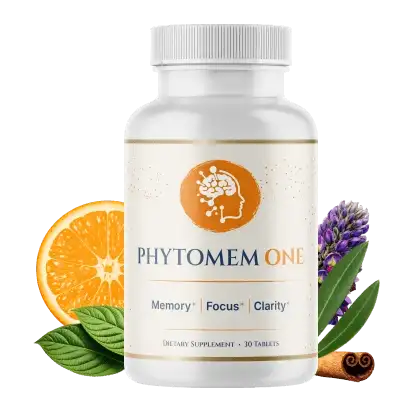
Phytomem One is a once-daily tablet marketed for memory, focus, and mental clarity in adults concerned about word-finding pauses and brain fog. Each bottle holds 30 tablets — a 30-day supply — and the directions are one tablet daily with food.
The formula names ten ingredients in three branded groups:
- Cellular Defense Matrix: saffron extract, fucoxanthin and fucoidan (both from Japanese sea kelp), and oleuropein from olive leaf
- Brain Fuel & Vitality Complex: berberine HCl, Ceylon cinnamon, corosolic acid from banaba leaf, and kudzu flower extract
- Neural Amplifier System: Morosil red orange extract and xylitol
The product is sold only through its official website, with ClickBank processing the order, and carries a 60-day money-back guarantee. Pricing runs from $158 for two bottles ($79 each) down to $294 for six ($49 each), with free US shipping on the three- and six-bottle packs.
The two central issues are dose disclosure and product-level evidence. The seller names all ten ingredients separately — which the company frames as a transparency commitment — but publishes no milligram amounts for any of them. And no clinical trial of the finished Phytomem One formula was located in any independent review reviewed for this article.
What’s in It
What’s disclosed: the names of all ten ingredients and the three branded group names.
What’s not disclosed: the milligram amount of every single ingredient, the blend total, excipient information, and a complete current Supplement Facts panel. Multiple reviews note that no Supplement Facts label is shown on the sales page at all. One review states it plainly: “No milligram amounts are published for any of the ten ingredients”.
A note on the “full formula” claim: a press release issued on the company’s behalf states that Phytomem One “follows the individually itemized approach, naming all ten of its active ingredients separately and assigning each a distinct presence on the label”. That is true as far as it goes — but naming an ingredient is not the same as dosing it. The release itself concedes that the labeling practice is “a matter of disclosure policy rather than a claim about efficacy”.

How It’s Positioned to Work
The marketing combines two narratives.
The “toxic brain shards” story: the sales videos are built on what the seller’s own affiliate page calls a “Toxic Brain Shards angle” — a microplastics discovery narrative. The underlying study is real: researchers at the University of New Mexico reported shard-like plastic fragments in brain tissue from deceased donors, with more in 2025 samples than in 2016 samples, and more again in people diagnosed with dementia.
What that study actually shows: it measured plastic, not memory. It found an association with dementia but did not show that plastics cause memory loss, and it did not test any way of removing them. No study has shown that any supplement removes microplastics from the brain.
The “metabolic brain” story: the formula’s second half — berberine, Ceylon cinnamon, banaba, Morosil — is built around blood sugar and glucose handling. That is a coherent thesis: research does link metabolic health with cognitive health. Berberine and Ceylon cinnamon carry strong meta-analysis support for glucose control.
Where the logic breaks: the formula’s ten ingredients lean heavily toward blood sugar and antioxidant support rather than memory mechanisms specifically. If your concern is memory, the question is whether those are the right levers — and no trial of the finished combination answers it. One review sums up the gap: “none of that research tested this product, and no dosages are published — so the most important number in the pitch is missing”.
What It May Be Good For
A stimulant-free, one-tablet routine. People who cannot tolerate stimulant-based focus products may find the format appealing, and one small tablet is easier to maintain than a multi-capsule stack.
A metabolic-brain approach for adults with borderline glucose markers. If your last blood panel showed borderline fasting glucose or A1c, the berberine-and-cinnamon half of the formula is at least aimed at a real physiological lever — though the dose remains unknown.
A 60-day trial with a real refund channel. The guarantee runs through ClickBank, which is the enforceable kind — vendor and network both back it, and the charge appears on your statement as ClickBank.
A long enough window for saffron’s evidence timeline. The two best-known saffron trials ran for 16 and 22 weeks, and the smallest order — two bottles — covers 60 days. That is short of the trial duration, but it is long enough to judge tolerance and early subjective change.
What to Keep Expectations Realistic About
Microplastic removal. No supplement has been shown to remove microplastics from the brain, and Phytomem One has never been tested for it.
Memory improvement in healthy adults. The saffron evidence is in people with mild cognitive impairment or Alzheimer’s, not healthy adults, and carries a high risk of bias rating.
Individual doses. All ten ingredients are undosed on the public label. Without knowing the amounts, the formula cannot be compared to any published trial.
A finished-product trial. None exists.
The review count. The sales page’s schema markup cites 4.8 stars across 47,000 reviews, but those reviews are hosted on the company’s own platform — not Amazon, Trustpilot, or a clinical database. One independent review site shows 142+ ratings and a 4.0/5 score; another shows 2.6/5; another 3/5.
A clean domain landscape. Independent trust checks on Phytomem One–branded domains have returned scores of 0/100 and 11/100, with flags for hidden WHOIS, recent registration, and “typical complaints of payment without delivery, wrong product, or inferior counterfeits”.
Safety for everyone. Berberine can interact with diabetes medicines and many other drugs and should not be taken during pregnancy. Kelp-derived ingredients can contain iodine, which matters for people with thyroid conditions. Xylitol is toxic to dogs.
Who It Suits
- Adults over 45 who notice word-finding pauses and want a stimulant-free option before things get worse
- People whose blood work shows borderline fasting glucose or A1c and who want a formula that addresses metabolic health alongside brain health
- Anyone who cannot tolerate stimulant-based focus products
- Buyers who prefer one small tablet to a multi-capsule ritual
- People willing to run their own 60-day trial and use the ClickBank refund if it does not suit them
Who Should Skip It
- Anyone taking metformin, insulin, or another glucose-lowering medication without clearing berberine with their prescriber first
- People who need published milligram doses before buying — Phytomem One does not provide them
- Anyone hoping to test one bottle cheaply — the minimum order is two bottles at $158
- People with thyroid conditions without checking the kelp-derived iodine content with a doctor
- Anyone with a diagnosed cognitive condition or new, worsening memory problems — those require assessment, not a supplement
- Shoppers who cannot verify the official checkout — look-alike domains exist, and purchases outside the official ClickBank funnel are not covered by the guarantee
Practical Buying Notes
- Confirm the price tier at checkout. The verified ladder is $158 for two bottles ($79 each) plus shipping, $177 for three ($59 each, free US shipping), and $294 for six ($49 each, free US shipping). The crossed-out $99 per bottle is a reference price, not something anyone pays.
- Note that there is no single-bottle option. The minimum real spend is $158, and the two-bottle pack runs out just as the 60-day refund window closes.
- Read the refund terms before paying. The 60-day window counts from receipt, and return shipping is paid by the buyer — which costs more from outside the US.
- Buy only through the official ClickBank checkout. Purchases through marketplaces, affiliate funnels, or look-alike domains are not covered by the guarantee, and the company itself has documented unauthorized listings and look-alike domains.
- Check the domain before entering payment details. Independent trust scores on Phytomem One–branded sites have returned 0/100 and 11/100, with hidden ownership and recent registration flags.
- Read the bottle label on arrival. The sales page does not show a Supplement Facts panel. The bottle is the only reliable record of what you received.
- Set a day-50 reminder if you intend to use the guarantee, so a fair trial does not drift past the window.
Bottom Line
Phytomem One is a coherently conceived but undisclosed and unproven cognitive supplement. The formula’s ten ingredients are not random — saffron has the strongest memory data, and the berberine-cinnamon-banaba group is aimed at a real metabolic lever — and the 60-day ClickBank refund is genuinely enforceable. Those are not nothing.
But the doses are completely unpublished, the finished formula has no clinical trial, and the “toxic brain shards” narrative rests on a microplastics study that did not test this product or any intervention. The review count is self-hosted and unverifiable, the domain trust record includes 0/100 and 11/100 scores, and the minimum entry point is $158 for a product whose own evidence timeline (16–22 weeks for saffron) outlasts the 60-day refund window. Independent reviewers score it anywhere from 2.6/5 to 4.0/5, which is itself a signal that the evidence does not settle the question.
Buy it only if you want a stimulant-free, one-tablet metabolic-and-antioxidant formula, you have cleared the berberine and kelp-iodine considerations with a pharmacist or doctor, you will buy only through the official ClickBank checkout, you will photograph the bottle label on arrival, and you will treat the 60 days as a documented personal experiment. Skip it if you need published doses, you take glucose-lowering or interacting medication without clearance, you have a thyroid condition without medical advice — or you are buying it because of the microplastics story, because no supplement has been shown to remove microplastics from the brain.
This article is for informational purposes only and is not medical advice. Statements about dietary supplements have not been evaluated by the FDA. Consult a healthcare professional before starting any supplement.
Editor’s notes: (1) Confirm or remove the author byline — do not use “Dr./MD” unless verified. (2) The absence of published milligram doses for all ten ingredients is the central factual point and must remain in the final copy — do not present the “individually itemized” labeling claim as dose transparency. (3) The “toxic brain shards” narrative is built on a microplastics study that did not test this product and did not test any removal intervention — keep that distinction explicit. (4) The berberine–diabetes medication interaction and the kelp-derived iodine caution are the relevant safety disclosures. (5) The 4.8/47,000 review figure is self-hosted and contradicted by independent scores ranging from 2.6/5 to 4.0/5 — present it as a seller claim, not an independent rating. (6) Do not link to any of the low-trust domains named in this review. (7) Verify current pricing and the 60-day-from-receipt refund terms at checkout before publishing. (8) Do not add testimonials or cognitive-efficacy claims beyond what is attributed here.
Read also
ProDentim Review — Oral Probiotic Chewable for Gum & Breath Support (November 2026)
Prostadine Review — Liquid Prostate & Urinary Support Drops