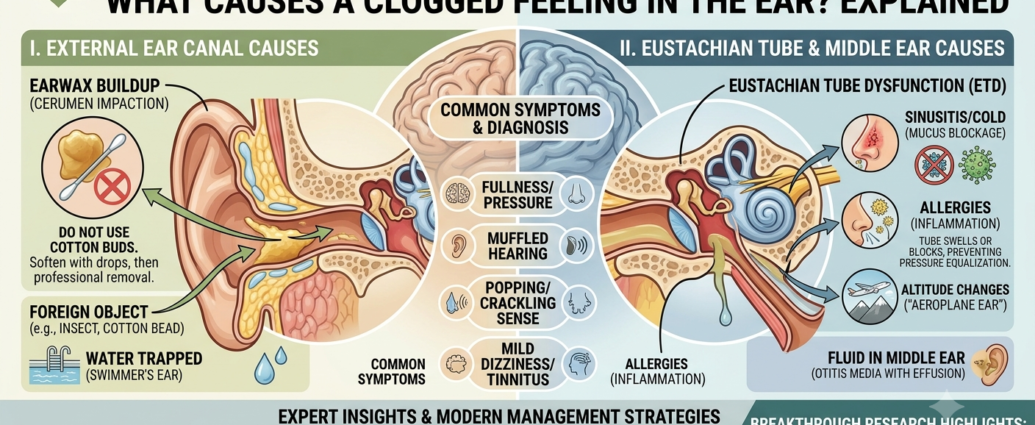
What Causes a Clogged Feeling in the Ear :Let me start by acknowledging something: a clogged, muffled feeling in your ear is one of the most common complaints I hear, and in most cases, it’s nothing to panic about.
I’ve spent years helping people understand their ear health, and I’ve seen how this sensation can cause unnecessary worry. It’s uncomfortable, it’s annoying, and it can make you feel like you’re hearing the world through a wall. But the good news? Most causes are temporary and easily treatable.
Let me walk you through what I’ve learned about why this happens and what you can do about it.
What Exactly Is This Clogged Sensation?
When your ears feel full, stuffy, or blocked, it usually means something is interfering with how sound reaches your eardrum or how pressure is balanced in your middle ear. People often describe it as:
- A feeling of fullness or pressure in the ear
- Muffled or dulled hearing
- Crackling or popping noises
- The sensation that your ear needs to “pop”
The two most common culprits? Earwax buildup and Eustachian tube dysfunction. Let’s explore both, along with other potential causes.
Common Cause #1: Impacted Earwax
Earwax, or cerumen, is actually your ear’s best friend. It cleans your ears and protects them from dust, dirt, and infection . Normally, your ears are self-cleaning—wax works its way out through natural jaw movements when you talk and chew .
Here’s the big mistake I see people make: They reach for a cotton swab to “clean” their ears. This almost always backfires, pushing wax deeper into the ear canal and making the impaction worse .
When wax becomes impacted, you might experience:
- A feeling of fullness in your ear
- Hearing loss, which may worsen over time
- Earache or itchiness
- Ringing in your ears (tinnitus)
- Dizziness
People who use hearing aids, earbuds, or earplugs regularly are at higher risk for wax buildup because these devices can push wax deeper with repeated use .
What to do: Over-the-counter ear drops can soften and break down earwax . However, never put anything inside your ear canal—including cotton swabs. If at-home methods don’t work, a healthcare provider can remove wax safely using special instruments, irrigation, or suction devices .
Common Cause #2: Eustachian Tube Dysfunction
The Eustachian tube is a narrow passageway connecting your middle ear to the back of your throat . Normally, it opens with every swallow or yawn to equalize pressure and drain mucus from the middle ear .
When this tube becomes blocked or doesn’t open properly, it’s called Eustachian tube dysfunction (ETD). This is a major reason why ears feel clogged, even when there’s no wax .
Common triggers include:
- Colds, flu, or sinus infections—Swelling and mucus can block the tube
- Allergies—Inflammation from allergic reactions
- Enlarged adenoids—Tissue at the back of the throat can cause blockage
- Smoking—Damages the tiny hairs that sweep mucus from the middle ear
- Obesity—Fatty deposits around the tube can contribute
- Changes in air pressure—Flying, scuba diving, or mountain driving
When the Eustachian tube is blocked, the lining of the middle ear absorbs trapped air, creating negative pressure that pulls the eardrum inward. This stretched eardrum causes pain, pressure, and muffled hearing .
What to do: Try yawning, swallowing, or chewing gum to help open the tube . For air travel, use these techniques during descent . Decongestants or antihistamines may help if allergies or sinus congestion are the cause .
Other Potential Causes
Sinus Congestion and Allergies
Sinus problems and allergies can block the Eustachian tube and cause a clogged ear sensation. This is why ear fullness often accompanies hay fever, colds, or sinus infections .
Ear Infections
Middle ear infections (otitis media) cause fluid to build up behind the eardrum, leading to pressure and discomfort . Children are more prone to ear infections, but adults can experience them too, especially during or after respiratory illnesses .
Trapped Water
Swimming, showering, or bathing can leave moisture in the ear canal, especially if you have narrow or curved canals . This is often called “swimmer’s ear” .
Barotrauma
Rapid changes in air pressure—such as during flying or scuba diving—can cause a temporary plugged feeling .
Less Common Causes
In some cases, ear fullness can be linked to:
- Temporomandibular joint (TMJ) disorders—Jaw issues that can cause ear fullness
- Migraine disorders—Some patients with unexplained ear fullness are diagnosed with migraine
- Meniere’s disease—An inner ear disorder causing vertigo, tinnitus, hearing loss, and ear fullness
- Sensorineural hearing loss—Inner ear damage that can create a muffled sensation
When to See a Doctor
Seek medical advice if your ear fullness:
- Lasts more than a week
- Is accompanied by severe or worsening pain
- Causes sudden hearing loss
- Is accompanied by dizziness or ringing
- Involves discharge from the ear
An ENT specialist can visually inspect your ear canal and eardrum, perform hearing tests, and provide appropriate treatment—whether that’s wax removal, medication for infection, or addressing an underlying condition .
Quick Self-Care Tips
- Avoid cotton swabs—They push wax deeper and can damage your eardrum
- Try over-the-counter ear drops—These can soften wax
- Yawn, swallow, or chew gum—Helps open the Eustachian tube
- Use gravity—If water is trapped, turn your head sideways and gently pull your earlobe
- Manage allergies and sinus congestion—Antihistamines or decongestants may help
Final Thoughts
A clogged ear can be annoying and uncomfortable. But in most cases, it’s caused by something simple and treatable. The key is understanding the root cause—whether it’s wax buildup, pressure issues, or an underlying condition.
Your ear health matters. If you’re experiencing persistent fullness, don’t hesitate to seek professional evaluation. Relief is often just a few simple steps away.
Disclaimer: I am not a medical professional. This article is for informational purposes only and does not constitute medical advice. Always consult a healthcare professional if you are concerned about your ear health.
Read also
YuSleep The Science of Better Sleep, Simplified